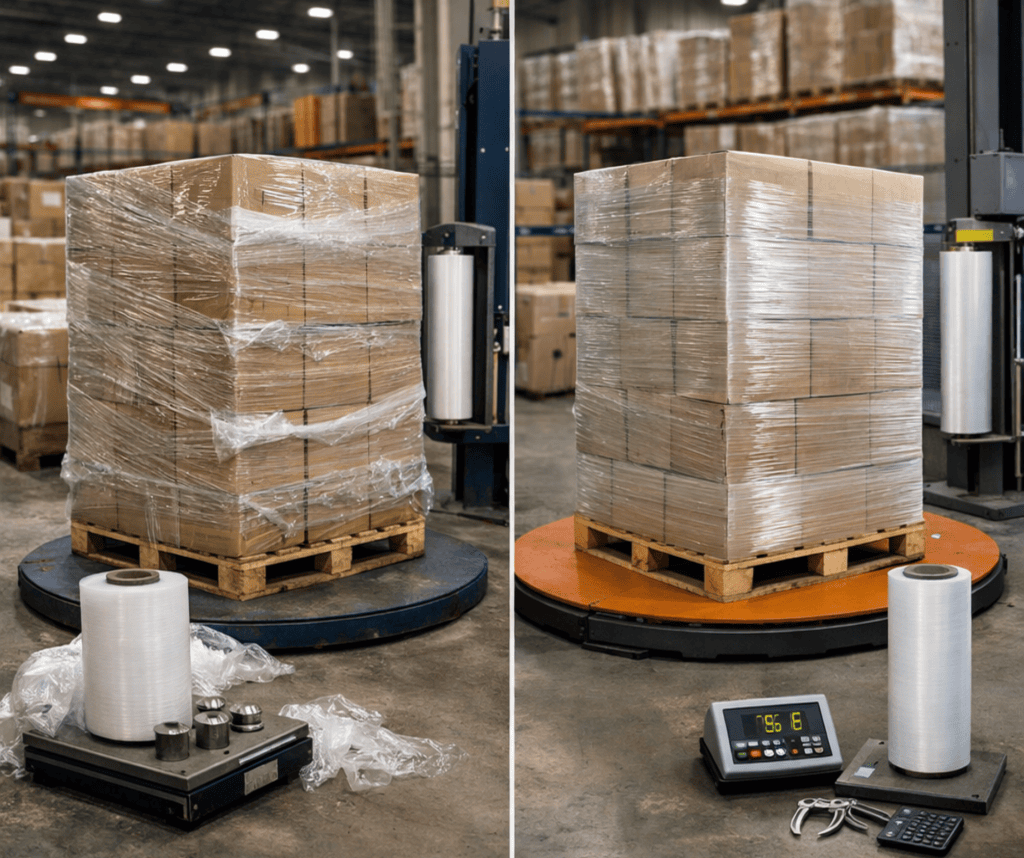
Ez elsőre logikusnak tűnik, a valóságban viszont sok esetben nem maga a meghibásodás okozza a legnagyobb költséget, hanem az, hogy a gép már nem tudja hatékonyan kezelni a modern stretch fóliákat.
Ilyenkor a gép még működik, csak közben:
- több fóliát használ,
- gyengébb a rakat stabilitás,
- lassabb a csomagolás,
- nagyobb a selejt és a leállás kockázata,
- és elveszik az a megtakarítás, amit egy korszerűbb rendszer tudna biztosítani.
A jó hír az, hogy nem minden esetben kell teljes gépcsere.Sokszor egy jól megválasztott upgrade is elég ahhoz, hogy jelentős fóliamegtakarítást lehessen elérni.
A legtöbb fóliázógép nem a fóliától „öregszik el”
Sok esetben nem maga a gép „öregszik el”, hanem egyszerűen már nem arra a fóliatechnológiára lett tervezve, amit ma a gyártók használnak.
Miközben a gépek hosszú éveken át stabilan működnek, a stretch fóliák fejlesztése rendkívül gyors ütemben haladt előre az elmúlt időszakban:
- vékonyabb anyagok,
- magasabb előnyújthatóság,
- jobb szakítószilárdság,
- PCR alapanyagok megjelenése,
- új gépbeállítási igények.
Egy 8–10 éves gép sok esetben még mindig stabilan működik mechanikailag, de már nem tudja megfelelően kezelni ezeket az anyagokat.
Ilyenkor gyakran az történik, hogy a cég:
- vastagabb fóliára vált,
- több menetet használ,
- csökkenti az előnyújtást,
- vagy egyszerűen „ráteker még egy kicsit biztosra”.
A probléma csak az, hogy ez hosszú távon jelentős pluszköltséget jelent.
Mikor elég egy upgrade?
Sok esetben nem kell teljes gépcsere, elég lehet:
- előnyújtó rendszer fejlesztése,
- szenzorcsere,
- fóliakocsi upgrade,
- hajtásmodernizáció,
- vezérlésfrissítés,
- vagy bizonyos kopó alkatrészek cseréje.
Egy jól megválasztott upgrade után a gép képes lehet:
- magasabb előnyújtásra,
- stabilabb fóliafeszítésre,
- egyenletesebb fóliafelhasználásra,
- és modernebb fóliák kezelésére.
A gyakorlatban ez sokszor 20–30%-os fólia felhasználás-csökkentést is jelenthet.
És itt fontos egy dolgot tisztázni: Nem a fólia kg ára számít igazán, hanem az, hogy végül mennyi fólia fogy el egy raklapra.
Egy magasabb teljesítményű fólia lehet drágább kilogrammra, mégis összességében olcsóbb megoldást adhat, ha kevesebb fogy belőle.
Mikor kell valóban gépet cserélni?
Van az a pont, amikor a meglévő rendszer már nem fejleszthető gazdaságosan.
Ez általában akkor történik meg, amikor:
- a gép mechanikailag elavult,
- nincs megfelelő alkatrészellátás,
- nem stabil a működés,
- túl sok a leállás,
- vagy az automatizálási igény már meghaladja a jelenlegi rendszer képességeit.
Ilyenkor a teljes gépcsere nem költség, hanem hosszú távú optimalizálás.
Különösen igaz ez olyan környezetben, ahol:
- nagy a raklapszám,
- fontos a folyamatos termelés,
- vagy jelentős a fóliafelhasználás.
A legnagyobb hiba: csak a gép árát nézni
Sok tender még mindig kizárólag beruházási ár alapján dől el.
Pedig két gép között hatalmas különbség lehet abban, hogy:
- milyen előnyújtást tud,
- hogyan kezeli a fóliát,
- mennyire stabil a fóliafeszítés,
- vagy mennyire lehet optimalizálni vele a felhasználást.
Volt olyan eset, ahol egy olcsóbb gép elsőre jobb ajánlatnak tűnt, de nem tudta azt az előnyújtási teljesítményt, amivel később jelentős fóliamegtakarítás lett volna elérhető. Ilyenkor a valódi költség évekkel később jelenik meg a túlzott fóliafelhasználásban.
A kérdés ma már nem az, hogy működik-e a gép
A valódi kérdés ma már az, hogy mennyire hatékonyan működik a gép. A stretch fóliázás ma már nem egyszerű csomagolási folyamat: hatással van a költségekre, a rakat stabilitásra, a fenntarthatósági célokra és a termelés folyamatosságára.
Sok esetben ehhez új gép kell, máskor elég egy jól átgondolt upgrade. A különbséget általában nem a katalógus mutatja meg, hanem a helyszíni audit és a mérések.
At most manufacturing companies, the same mindset appears when it comes to stretch wrapping machines: “As long as it works, there’s no need to touch it.”
At first glance, this seems logical. In reality, however, the biggest cost is often not the machine breaking down, but the fact that it can no longer efficiently handle modern stretch films.
In these cases, the machine is still operating, but meanwhile:
- it uses more film,
- pallet stability is weaker,
- packaging is slower,
- the risk of waste and downtime is higher,
- and the savings that a more modern system could provide are lost.
The good news is that a complete machine replacement is not always necessary. In many cases, a well-chosen upgrade is enough to achieve significant film savings.
Most wrapping machines do not become “obsolete” because of the film
In many cases, the machine itself does not really become “old.” The issue is simply that it was not designed for the film technology manufacturers use today.
While machines may continue operating reliably for many years, stretch film technology has evolved extremely quickly in recent years:
- thinner materials,
- higher pre-stretch capability,
- better tensile strength,
- the introduction of PCR materials,
- and new machine setup requirements.
An 8–10-year-old machine may still work perfectly from a mechanical standpoint, but it often cannot properly handle these modern materials.
As a result, companies frequently end up:
- switching to thicker film,
- using more wrapping cycles,
- reducing pre-stretch,
- or simply “adding a little extra wrap to be safe.”
The problem is that, over the long term, this creates significant additional costs.
When is an upgrade enough?
In many cases, a full machine replacement is unnecessary. It may be enough to upgrade:
- the pre-stretch system,
- sensors,
- the film carriage,
- drive systems,
- control systems,
- or certain wear components.
After a properly selected upgrade, the machine may become capable of:
- higher pre-stretch ratios,
- more stable film tension,
- more consistent film usage,
- and handling modern film types more effectively.
In practice, this can often result in a 20–30% reduction in film consumption.
And one important thing needs to be clarified here: the real cost is not the price per kilogram of film, but how much film is ultimately used per pallet.
A higher-performance film may cost more per kilogram, yet still provide a lower overall cost if less material is required.
When is a full machine replacement truly necessary?
There comes a point when the existing system can no longer be upgraded economically.
This usually happens when:
- the machine is mechanically outdated,
- spare parts are no longer available,
- operation is unstable,
- downtime becomes too frequent,
- or automation requirements exceed the system’s capabilities.
In these situations, a complete machine replacement is not merely an expense, but a long-term optimization investment.
This is especially true in environments where:
- pallet volumes are high,
- continuous production is critical,
- or film consumption is significant.
The biggest mistake: focusing only on the machine price
Many tenders are still decided solely based on investment cost.
However, there can be enormous differences between two machines in terms of:
- achievable pre-stretch performance,
- how the film is handled,
- the stability of film tension,
- and how effectively usage can be optimized.
There have been cases where a cheaper machine initially appeared to be the better offer, but it could not deliver the pre-stretch performance required to achieve substantial film savings later on. In such cases, the real cost only becomes visible years later through excessive film consumption.
Today, the question is no longer whether the machine works
The real question today is how efficiently the machine works.
Stretch wrapping is no longer just a simple packaging process. It directly affects costs, pallet stability, sustainability goals, and production continuity.
In some cases, this requires a new machine. In others, a carefully planned upgrade is enough. The difference is usually not revealed in a product catalog, but through on-site audits and performance measurements.